How it's made

From forest floor
to finished piece.

Every Parker & Bark table starts with a walk through Augusta's hardwood forests. Six steps later, it leaves with a hand-written care card and Andrea's signature on the underside. Here's what happens in between.

Black walnut hardwood slab from Augusta Georgia forest, Parker and Bark
Step 1 — Sourcing [Swap for logs/slabs photo]
01

Sourcing

Every piece starts locally. Augusta and the surrounding counties grow some of the finest hardwoods in the Southeast — black walnut, white oak, pecan, cedar, cypress — and that's where the wood comes from. Storm-fall and selective harvest only. Nothing taken without purpose.

The sourcing walk is where a piece begins in earnest. Not every felled tree becomes a table. The right candidate has interesting grain structure, solid heartwood, and enough character to justify the work. Most don't make the cut. The ones that do are worth the search.

Read more about Andrea's approach and what drives the work.

Wood species: Black walnut, white oak, pecan, cedar, cypress — sourced within the Augusta region.

Live edge wood slabs air drying on stickers before kiln, Parker and Bark shop
Step 2 — Drying [Swap for stickered slabs photo]
02

Drying & Stabilizing

Green wood moves. It checks, warps, and twists as moisture leaves the cells — and if you skip this step, the furniture follows. Slabs go on stickers to air-dry first, stacked with airflow on all sides. Then into the kiln, where temperature and humidity are controlled until the wood reaches 8–10% moisture content.

A moisture meter makes the call. Not a calendar, not intuition — a meter reading confirming the wood is ready. Rushing this step is how furniture fails in five years. A properly dried slab is dimensionally stable for the life of the piece.

Why it matters: Kiln-dried to 8–10% MC — the stability baseline for furniture that lives indoors year-round in Georgia's climate.

Live edge slab being examined for grain and natural character, Parker and Bark
Step 3 — Reading [Swap for slab examination photo]
03

Reading the Wood

Before any cutting, the slab and branch base get paired and studied. Grain direction, color tone, natural figure — these determine how the pieces will live together in the finished table. A mismatched pairing shows immediately. A well-matched one disappears into itself.

Knots, checks, and live edges are features in this process, not defects to work around. Knots are where branches grew. Mineral streaks are where the tree pulled iron from the soil. Checks are the wood's natural response to stress. All of these get acknowledged and worked with, not against.

Voids get filled with clear epoxy. Active checking — a crack that's still traveling — gets stopped with bow-tie inlays cut from contrasting wood. See the care guide for how these age.

Epoxy fills and bow-ties: Functional, not decorative — each one stops movement and stabilizes the slab for the long term.

Mortise and tenon joinery on branch base table leg, handcrafted Augusta Georgia
Step 4 — Joinery [Swap for mortise/pin photo]
04

Joinery

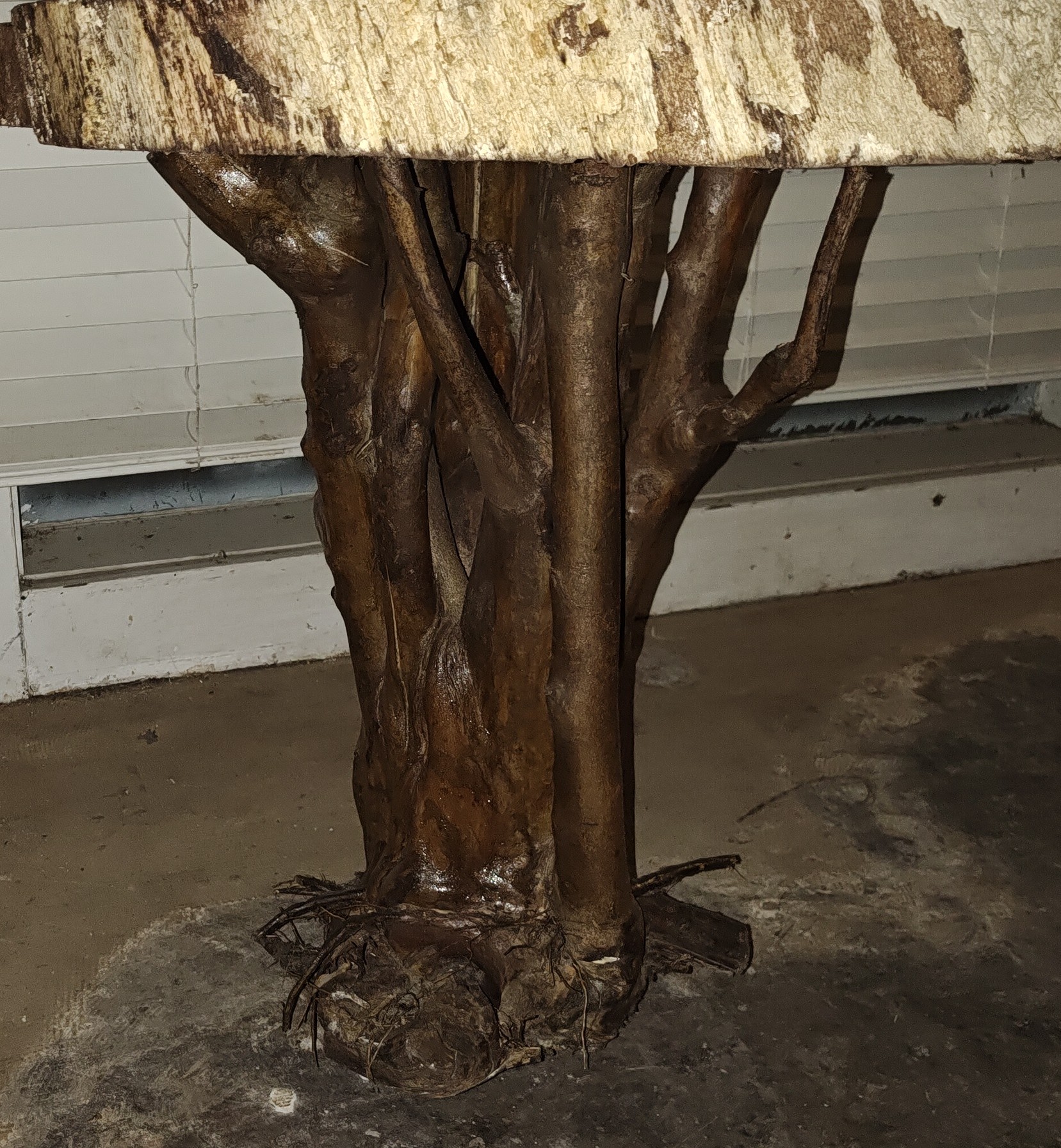
The branch base and slab are joined by mortise-and-tenon or hidden steel pin — the same joints used in furniture that has survived centuries. No MDF. No particle board. No veneer anywhere in the piece. Every material is what it appears to be, and the joints are built to hold through decades of seasonal wood movement.

The branch base itself is the signature of the work. Narrow logs or clustered branches rise from the floor to meet the slab above. The table's silhouette is determined by how the tree grew — not by a designer's preference for a particular profile. No two pieces share the same stance.

Interested in a custom commission? The joinery is specified in the consultation — bark-on or bark-off base, species, and structural requirements all get worked out before a single cut is made.

No shortcuts here: Mortise-and-tenon or steel pin — the joint is hidden, the hold is permanent.

Hand sanding a live edge walnut slab, Parker and Bark finishing process
Step 5 — Finishing [Swap for sanding/finish photo]
05

Finishing

Hand-sanded from 80 through 220+ grit — progressively finer until the surface is smooth without losing the character underneath. The grain, figure, and texture of the wood should come through the finish, not disappear beneath it. That's the goal at every sanding stage.

Food-safe hardwax oil for pieces that will see food and drink. Polyurethane for pieces that need harder protection. Both options preserve the natural look while sealing the wood against the daily wear a table takes. Bark-on pieces have every edge and the bark surface sealed during this step.

The finish makes the piece livable. The care guide covers how to maintain it over years of use — including a finish refresh every 6–12 months for tabletops that see regular contact.

Finish options: Food-safe hardwax oil (natural look, renewable) or polyurethane (harder protection) — specified at order.

Parker and Bark table signed by Andrea on the underside, with handwritten care card
Step 6 — The Final Hour [Swap for signature/care card photo]
06

The Final Hour

Before the piece leaves the shop, Andrea signs the underside. Every table gets a name — the tree species, the place it grew, or in the case of a custom commission, often the person it's made for. Parker has already given his approval. The care card is written by hand and goes with the delivery.

The name and the signature matter because this is the end of one story and the beginning of another. The tree grew somewhere specific, for decades, before ending up here. That provenance is worth remembering. The piece will outlast most of what's in your home — it should know where it came from.

Ready to start a piece of your own? Start a custom order →

Every piece includes: Andrea's signature + piece name on the underside, hand-written care card, Parker & Bark maker mark.

Ready to commission a piece

Six steps. Months of work. One table that lasts a lifetime.

Custom commissions are available for dining tables, coffee tables, side tables, and statement pieces. Every piece is one of one — tell us what you're thinking.

Start a Custom Order See Available Pieces